
LORO-X GeDaTi Parapet Drainage
Advantages and objectives
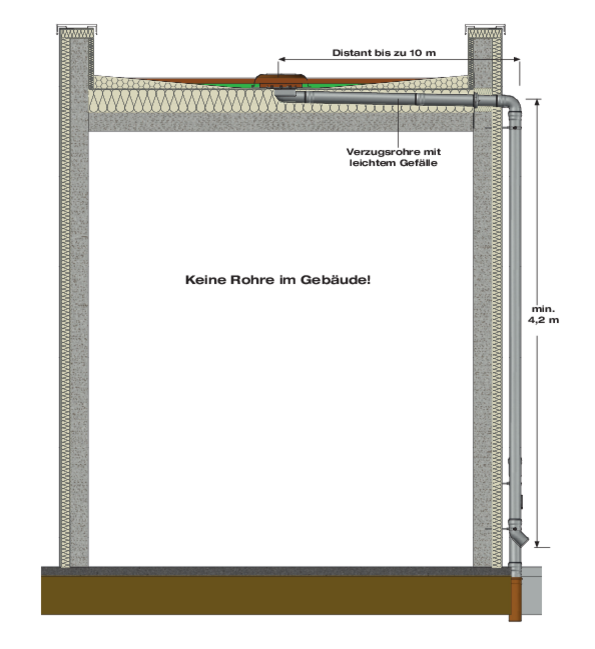
The flat roof drainage of many modern buildings is to be carried out with external pipes in order to be able to use the interior freely, or to avoid flow noise and thermal bridges.
On the other hand, there is often the desire to arrange the low points of the slope insulation as close to the centre of a partial area as possible. The "height" of the slope insulation can often be reduced with an all-round slope - as opposed to a one-sided slope.
The objective is therefore to create an external parapet drainage system where the slope can still run towards the centre of the roof.
Available and required starting flow rate
Unlike conventional parapet drainage systems, the water must overcome a long, horizontal distance with a higher pressure loss from the drain to the downpipe. For this, the water must be "pushed" to the downpipe by overpressure.
This water quantity is then available to the downpipe for starting and is therefore called the "available starting flow rate".
However, for the water-air mixture in the downpipe to form a pumping water column (starting), a certain minimum water quantity is required.
The minimum water quantity required for starting is called the "required starting flow rate".
Optimisation
The object-specific hydraulic optimisation then calculates which nominal diameters are needed for horizontal and vertical pipelines in order to overcome the given horizontal length and to start the available vertical pipeline.
| LORO-X Sloped Roof Low Point Parapet Drainage (GeDaTi) with clamping flange, for bitumen-plastic waterproofing membranes, stainless steel, acc. to EN 1253, DN 100 |
|||||
| DN100 | |||||
|
Main drainage Siphonic drainage |
13992.100X | 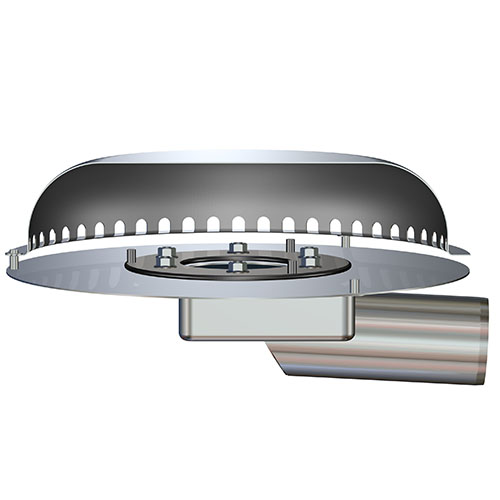 |
|||
|
Emergency drainage Siphonic drainage |
13993.100X | 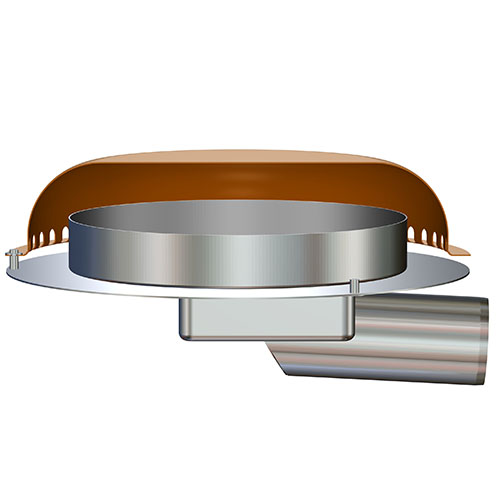 |
|||