
LORO-X Roof Drainage Systems in Ventilated Rainscreen Facades (VHF)
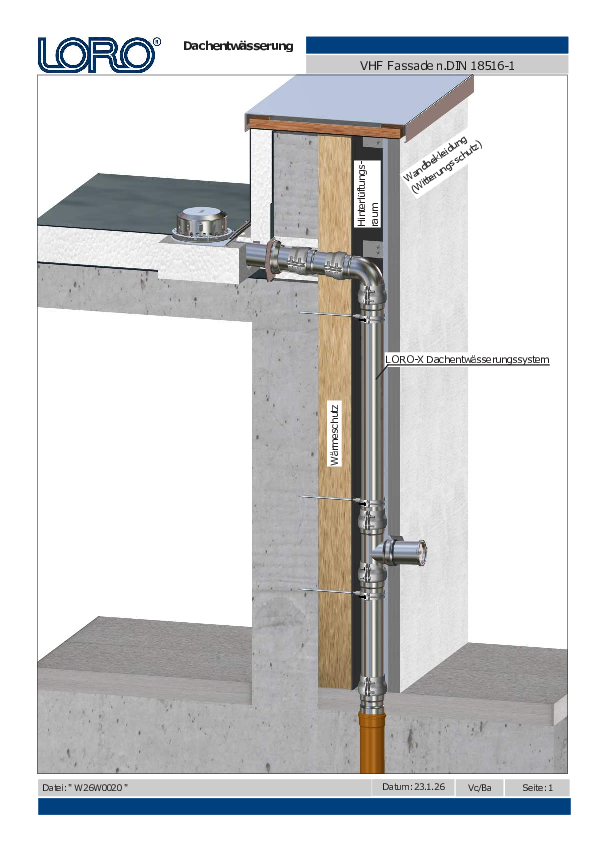
The ventilation cavity of VHF facades according to DIN 18516-1 is suitable for routing the downpipes of LORO-X parapet drainage systems. LORO-X steel drainage pipes can be routed invisibly between insulation and facade cladding – protected, maintenance-friendly and non-combustible.
VHF Design Principle
The VHF structurally separates thermal protection and weather protection. Between mineral insulation and the outer cladding, a ventilated cavity is created that removes moisture through a permanent airflow. This cavity simultaneously provides space for downpipes – a third option alongside visible external mounting and internal pipe systems.
Fire and sound protection: LORO-X pipes made of hot-dip galvanised steel or stainless steel are non-combustible (building material class A1) and thus meet the “non-combustible” requirement provided for by the FVHF fire protection guideline for components in the ventilation cavity. Massive LORO-X steel drainage pipes are also acoustically more favourable than thin-walled pipes due to their material properties.
Maintenance: Cladding elements of the VHF can be dismantled, so that the facade can be opened section by section during repairs. LORO-X cleaning pipes enable easy cleaning of the downpipe.
Planning
Facade and MEP planners coordinate pipe fixings and the depth of the ventilation cavity with the nominal diameter, e.g. DN 50 or DN 70.
Dismantling
The VHF often enables sorted dismantling and reuse of the components. LORO-X steel drainage pipes are also suitable for this.
Advantages
- Invisible pipe routing
- No pipes inside the building, full use of interior space
- Non-combustible, building material class A1
- Demountable facade and cleaning pipes for maintenance
- Recyclable materials