
Embedding in concrete
of drains and pipes
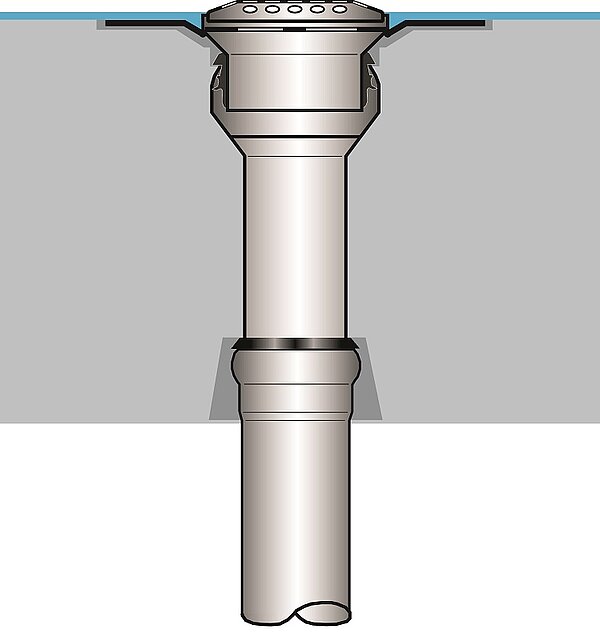
The embedding of hot-dip galvanized drains and steel discharge pipes in concrete has been state of the art for years. If the concrete is prepared in a manner compatible with the galvanization, based on previous experience an external coating can be omitted.
If admixtures such as antifreeze, retarders or rapid-setting agents are used in the concrete, the pipe should be coated externally as well, either at the factory or on site, or be given a protective coating on site using standard building protection products. These additives are mixed in mainly during the colder winter months.
On request, LORO can apply the external coating to the contact surfaces with concrete on the drains at the factory. However, since this has to be done manually, a surcharge must be taken into account.
Embedding in concrete can lead to increased structure-borne sound transmission and therefore to deviating sound measurement values.
Shuttering bell
A shuttering bell can be used when embedding drains or pipes in concrete, particularly for balconies, in order to visually conceal the push-fit socket connection on the underside within the concrete slab. The shuttering bell is fitted onto the pipe during embedding and removed again afterwards.
This creates an annular gap around the pipe at the position of the shuttering bell within the concrete slab, large enough to accommodate the socket of the pipe following below.
For special drains with a bell, a separate shuttering bell is not necessary.