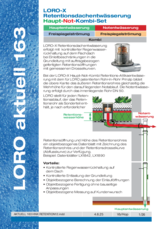
Products for retention:

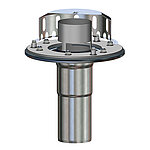
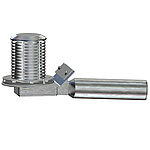
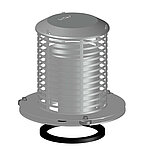
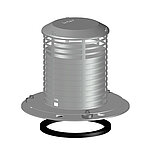
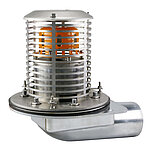
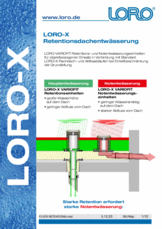
A strong retention requires a strong emergency drainage
LORO-X retention roof drainage in an application example
Due to the increase in restrictions concerning the piping of rainwater into the ground pipe, the retention of rainwater becomes more and more important. If there is no space for a retention basin or for seepage into the soil, the discharge into the ground pipe via the retention pipe with retention openings calculated specifically for the project will be strongly reduced. Consequently, only a small amount of rainwater flows from the roof into the ground pipe; the rest is held back on the roof in a controlled manner.
The small retention discharge (also called throttle discharge) means that the water retained on the roof is still discharged into the ground pipe long after the rainfall event. Thus, the discharge from the roof is spread over a longer period and the ground pipe is relieved at peak times.
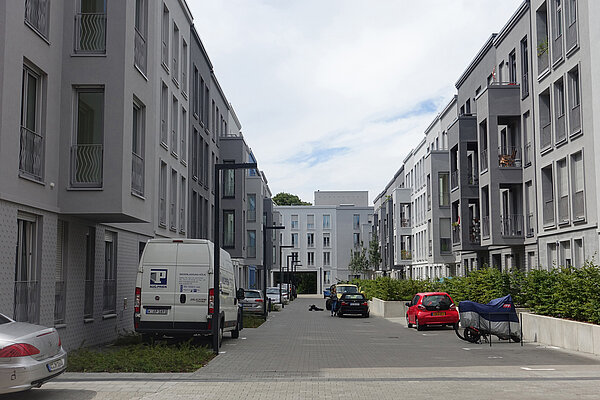
An urban residential complex with several part roof areas has already been equipped with diverse LORO-X parapet and flat roof drainage systems.
Six months after completion, it became known that the municipality requires a discharge restriction for the residential area.
Thus, the existing drainage concept was “too powerful”. That is why the drainage into the ground pipe had to be throttled afterwards.
What is a retention roof?
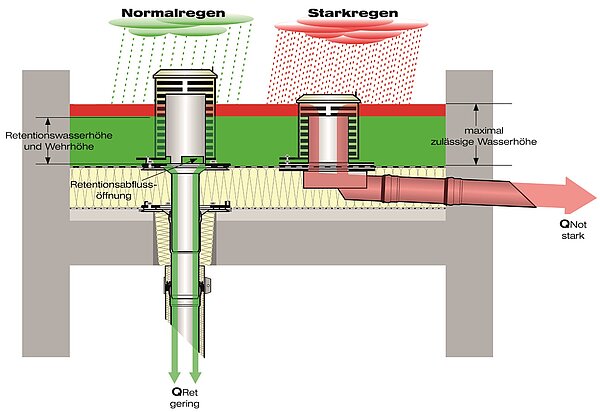
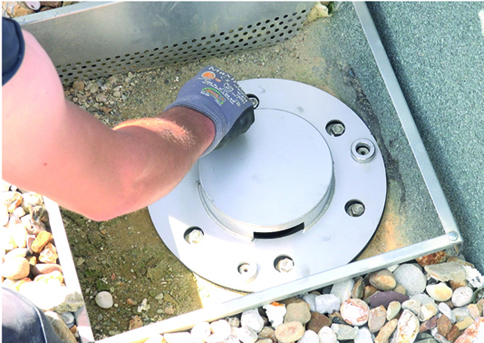
During a normal rainfall event, the discharge of the main drainage into the ground pipe is strongly throttled by the retention pipe, so that only a small proportion of the water arriving on the roof flows into the ground pipe.
This throttled discharge means that the retained water is still released into the ground pipe long after the rainfall event. In this way, the discharge from the roof is spread over a longer period and the ground pipe is relieved at peak times.
Discharge restriction into the ground pipe
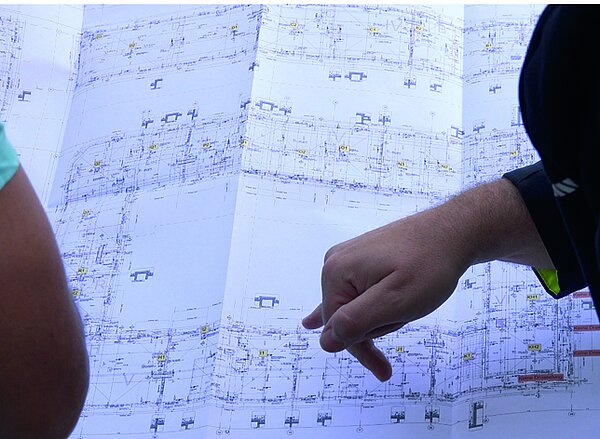
The basis of the calculation was specified by the municipality in the form of the discharge restriction. The maximum discharge into the ground pipe of 0.7 l/s per drain (retention discharge) must not be exceeded.
Based on the local rainfall intensity, the size of the roof areas and the assumed rainfall duration, the volume of water that falls on the roof areas as inflow is calculated. The volume drained as retention discharge during the same rainfall duration is subtracted from this, which gives the difference volume to be retained.
The difference volume in m3 is now divided by the roof area in m2 to obtain the retention water height. In this case 60 mm.
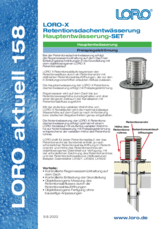
LORO-X VARIOFIT retention unit
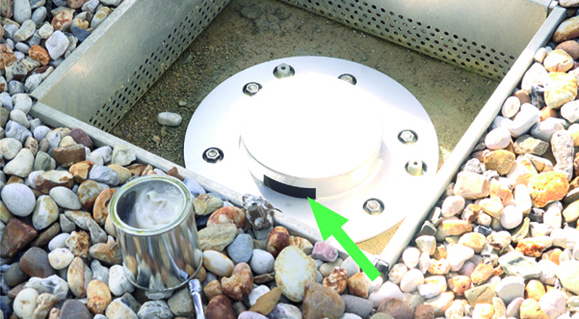
On the basis of the expected retention water height and the given retention drainage, the size of the lateral retention drain openings in the retention pipe is calculated (green arrow).
For the calculation, the LORO-X calculation programme for retention is used. Thereby a formula that has been confirmed through measuring is applied. The calculation ensures a discharge of exactly the amount of water from the retention water height that is demanded by the restrictions. If a permanent retention of water on the roof is desired, the retention drain openings can be adjusted. When adjusting the openings, the bottom edge of the retention drain openings should match the height of the permanent retention.
The LORO-X VARIOFIT retention unit is manufactured specifically for the project and delivered ready for installation. It can be easily installed on already existing parapet and flat roof drains of the series LORO-X RAINSTAR, DRAINLET and DRAINJET. Thus, it is suitable for new buildings as well as for renovation.
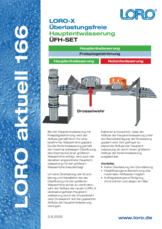
LORO-X VARIOFIT emergency drainage with variable-height weir
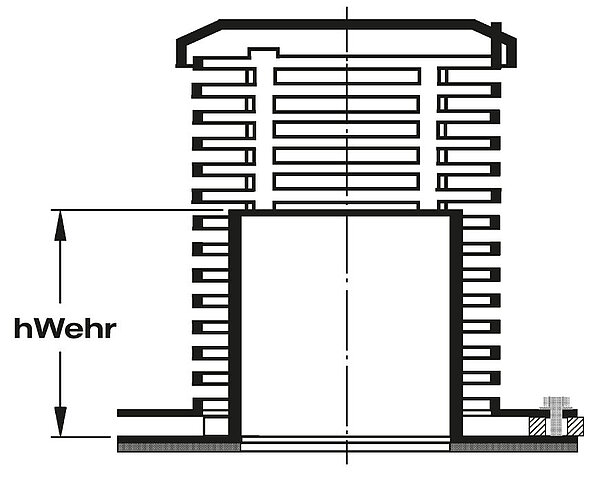
If it (a) rains longer than the planned minutes or if (b) the rain is stronger than specified by the standard, the actual water volume will exceed the calculated water volume on the roof. Thus, the retention water height is exceeded and the emergency drainage has to take place into the open.
Due to throttling the main drainage to a small discharge, the emergency drainage has to be designed so powerful that at least the difference between the century rain and the retention discharge can be discharged. Usually, even an additional security measure is taken: the emergency drainage has to be able to drain the complete century rain alone.
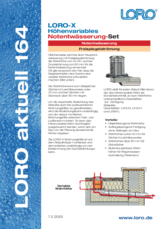
The height of the congestion element of the emergency drainage has to be adapted specifically for the project to the retention water height of the main drainage with retention.
The maximum permissible water height indicates how high the water is allowed to congest during the operation of the emergency drainage. In this case 80 mm.
Consequently, for the operation of the emergency drainage only a function range consisting of the difference between the maximum water height and the height of the congestion element is available. In this case, only a small function range of 20 mm is possible although a high discharge rate of 8 l/s is required for the emergency drainage.
The emergency drainage is selected by comparing the flow graphs of different emergency drainage systems that reach the required discharge at the possible function range. Hence, in this case at a function range of 20 mm.
From planning to installation

The interplay between main drainage with retention and emergency drainage with variable-height weir is especially important for the retention roof drainage because the weir height of the emergency drainage varies with the retention water height of the main drainage.
LORO-X VARIOFIT flow aids can be easily installed on already existing parapet and flat roof drains of the series LORO-X RAINSTAR, DRAINLET and DRAINJET.
Thus, they are suitable for new buildings as well as for renovation.
Video: Strong retention needs strong emergency drainage
Video: Project report
LORO News