
Discharge onto other roof areas
Only permitted in exceptional cases in accordance with DIN 1986-100 6.3.3
As a general principle, the free discharge from higher roofs onto roof areas located below should be avoided, in order to prevent uncontrolled flooding and to avoid weakening the waterproofing at the discharge point at single spots. The rainwater coming from above is preferably routed in a controlled manner with a pressure-resistant pipe system across the roof or roof-terrace area located below.
DIN 1986-100 6.3.3: "In exceptional cases, rainwater may be discharged via free outlets onto lower roof areas; in doing so, the rainwater must be directed away from rising parts of the building. In the area where the rainwater lands, the waterproofing or the roof covering must be reinforced where necessary."
With a pressure-resistant pipe system
Preferred solutions for set-back storeys and cascades
Particularly suitable solutions for set-back storey and cascade drainage route the rainwater in a controlled manner across several storeys, and can even drain the rainwater of the storeys located below at the same time, using multi-storey outlets in a single collecting pipe:
LORO-X QUATTROFLUX set-back storey drainage (main/emergency combination)
LORO-X DUOSTREAM cascade drainage
Alternatively, the pipe system of the roof drainage can be routed "simply" through the storey located below, using special pipe penetrations and fittings. In that case, however, the main and emergency drainage on each storey located below must be provided as additional drainage systems, which in the case of several storeys can lead to a large number of downpipes.
Without a closed pipe system
Risks of free discharge onto other roof areas
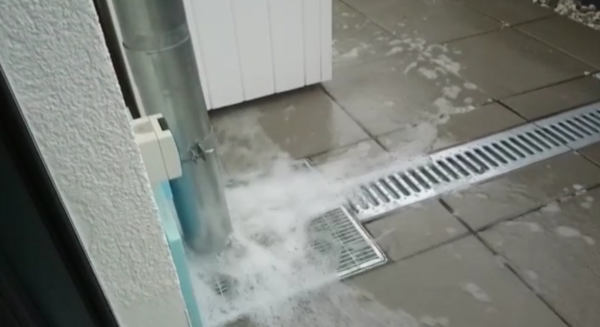
If the rainwater coming from above is nevertheless to be discharged freely onto areas located below, at least the special safety measures mentioned above regarding the waterproofing and the direction of flow must be taken. In addition, the risk of flooding in the area of door thresholds on used areas, such as roof terraces, must be taken into account.
The considerably higher flow velocity at the discharge point onto the lower roof area must also be carefully observed. In the downpipe located above the outlet - often several metres high - the water accelerates to up to several metres per second, which in the case of free discharge can lead to undesirable effects.