
Drainage Levels
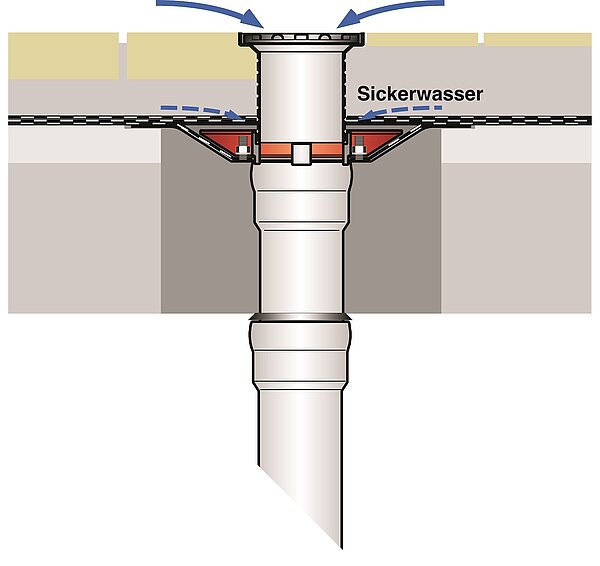
Outlets are distinguished by 1 or 2 drainage levels in particular for balcony drainage with the various balcony constructions. Not to be confused with Two-Part Design.
1 Drainage Level
With drainage on one drainage level, rainwater is discharged exclusively from one level, e.g. via the tile or paving slab covering laid in a mortar bed on a waterproofing membrane. Balcony drainage on one level is also used with balcony slabs made of precast concrete units of water-impermeable concrete, which usually receive no further build-up such as tiles in a mortar bed. With paving slabs on support pads, drainage can also take place exclusively on one level beneath the slabs, provided the slab spacing ensures sufficient discharge of the rainwater through the joints.
2 Drainage Levels
Drainage on two levels - an upper and a lower drainage level - is used, for example, with balconies featuring paving slabs in a bedding of gravel, chippings, etc. or on support pads. Rainwater that reaches the waterproofing membrane through joints that are not intentionally sealed during slab laying is, in the lower drainage level of LORO balcony drainage systems, discharged into the outlet via drainage rings or strainer pipes depending on the outlet type. To ensure their function, the bedding in the area of the outlet must be made of coarse gravel.
Discharge Curve with 2 Drainage Levels
Effect of 2 drainage levels on the discharge curve in the LX data sheet
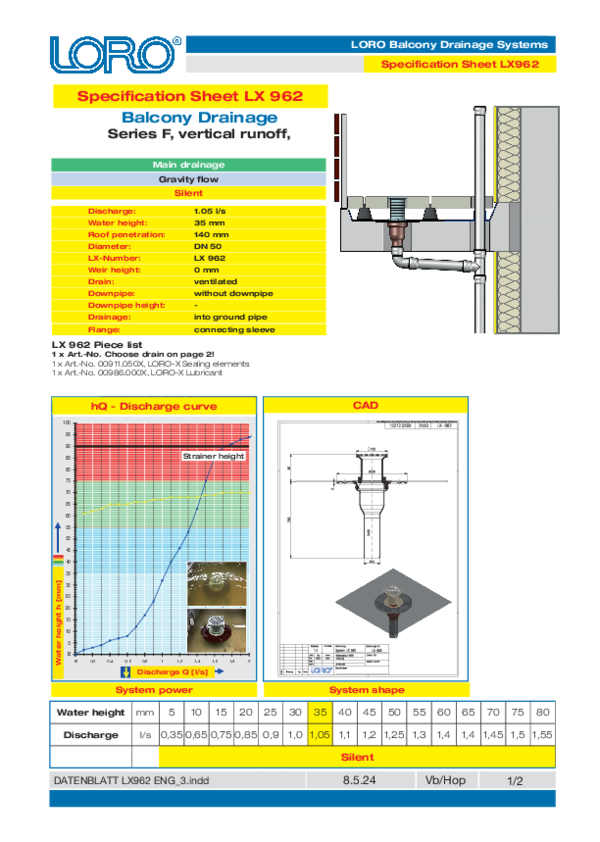
Balcony outlets with a strainer unit and drainage ring have two drainage levels: the lower drainage level via the drainage ring at the height of the waterproofing membrane, and the upper drainage level above the strainer unit at the height of the paving slab covering.
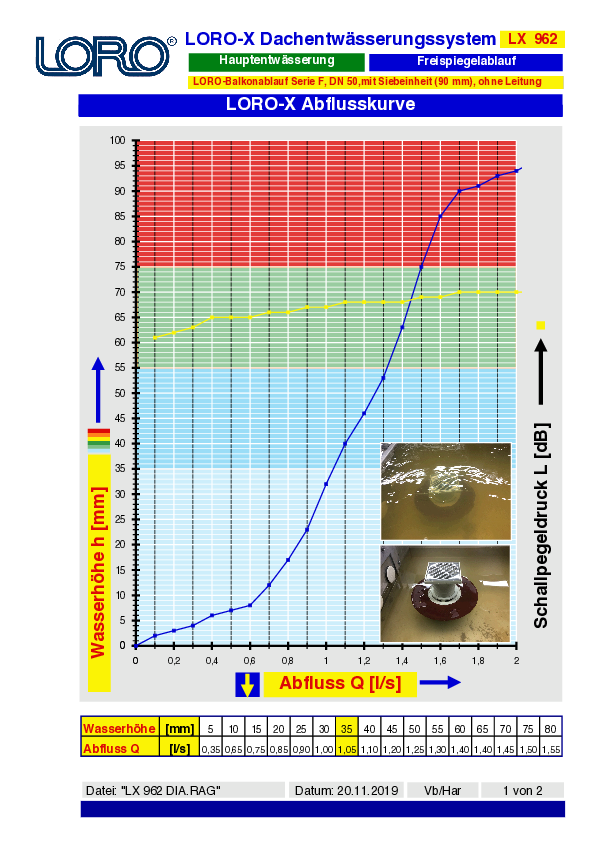
According to the standard, the nominal discharge for free surface flow is specified at a nominal water height of 35 mm. Usually the nominal water height refers to the waterproofing level (lower drainage level).
When examining the LX data sheet of balcony outlets with a strainer unit and drainage ring for 2 drainage levels, it must therefore be noted that at the nominal water height of 35 mm only the lower drainage level drains via the drainage ring.
During the system test, discharge through the upper drainage level only begins once the water height rises above the height of the strainer unit. In the installed condition, however, discharge takes place simultaneously from the upper and lower drainage levels into the outlet, since the paving slab covering allows inflow to the strainer unit from the outset.
Example
The adjacent example LX 962 with a 90 mm high strainer unit illustrates the effect on the discharge curve:
At the nominal water height of 35 mm, the discharge of 1.05 l/s takes place solely through the drainage ring.
Above a water height of 91 mm, the discharge of 1.8 l/s takes place through the drainage ring (lower drainage level) and additionally through the upper strainer of the strainer unit (upper drainage level).