
Greasy Wastewater
LORO-XCL stainless steel drainage pipes for greasy wastewater in restaurants and commercial kitchens
With LORO-XCL stainless steel drainage pipes, a long service life can be achieved for inlet and ventilation lines for standard grease separators. For different stress levels, we manufacture from stainless steel in material numbers 1.4301 (AISI 304) as standard and 1.4404 (AISI 316L) for higher demands. For connecting socket pipes and fittings, connections with NBR seals have proven themselves excellently over many years of use. Businesses where greasy wastewater typically occurs and the installation of grease separation systems is required include, for example, restaurants, commercial kitchens, butcher shops, and slaughterhouses.
The standards-compliant planning and execution of inlet lines to the grease separator as well as the associated ventilation lines place high demands on the sanitary professionals involved. If additional measures to prevent fat accumulation and deposits in the inlet lines to the separator system are necessary, these should ideally be coordinated with the grease separator manufacturer.
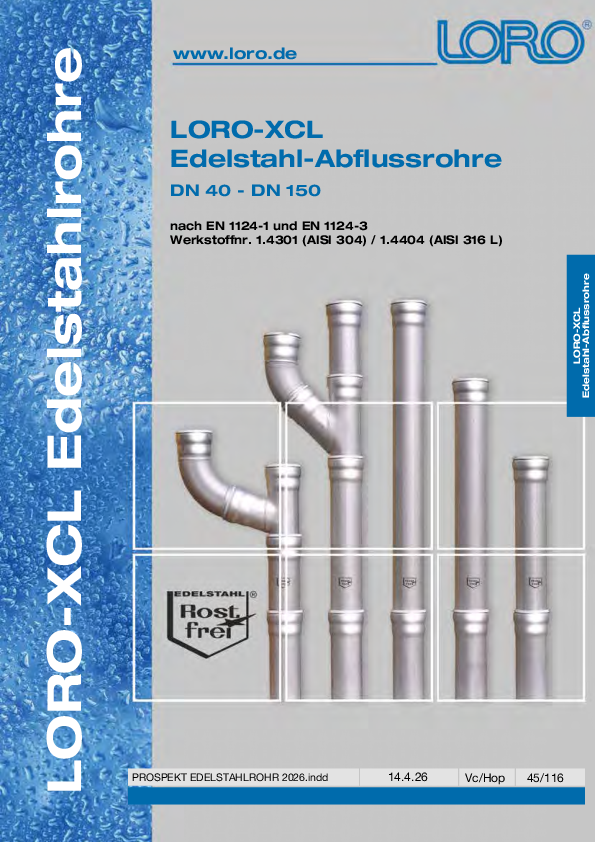
LORO-XCL Stainless Steel Pipes
High resistance and long service life for the inlet and ventilation of grease separators
- Strong wall thickness
- Building material class A1 non-combustible
- Pressure and backflow resistant
- LORO-X push-fit socket
- Comprehensive range up to DN 150
- Materials 1.4301 or 1.4404
- Special parts on request
The wall strength of LORO-XCL stainless steel drainage pipes is significantly higher in common nominal diameters than conventional stainless steel pipes for drainage, achieving longer service life and resistance even under high stress. You achieve significantly higher safety when draining problem wastewater in commercial kitchens, industry, and commerce where conditions are hot and aggressive.
LORO-XCL stainless steel drainage pipes also use the original LORO-X 2-chamber push-fit socket connection. Especially at higher flow velocities, vibrations, and pressures in the pipe system, there is higher safety compared to conventional O-rings or simple push-fit sockets, as the second socket chamber fixes the connection centrally and ensures deeper insertion.
Inlet to Grease Separator
LORO offers a comprehensive range of fittings and cleaning pipes for the inlet of greasy wastewater to the grease separator. The wastewater to the grease separator must be executed with free gradient. Turbulence of the wastewater must be avoided by, for example, providing sufficient calming sections after downpipes in the grease separator inlet pipe. The drainage lines should have sufficient cleaning openings so that quick inspection or cleaning of the lines is possible if needed.
Ventilation
For penetration through the roof, LOROFLEX flat roof penetrations with LORO-XCL ventilation pipes are suitable. Inlet and outlet lines of grease separators must be ventilated with a separate line directly above the roof. The distance to intake openings of ventilation and air conditioning systems must be observed.
Outlet from Grease Separator
The pressure line from the collection tank must reliably lift wastewater above the backflow level into the sewer, empty after each pump cycle, and simultaneously meet the hydraulic requirements of DIN EN 12056-4 and the DIN EN 12050 series. These requirements are determined by the building services planner and the lifting system manufacturer. For these high demands, LORO-X stainless steel drainage pipes are the first choice: They resist chemicals and corrosion, maintain their dimensional stability even at temperature peaks, and offer optimal flow with their smooth inner surface. Suitable safety clamps facilitate longitudinally force-locked installation.
Dimensioning
For dimensioning the inlet and ventilation lines, LORO offers pipes and fittings up to nominal size DN 150 as standard. When installing the lines, the laying and fixing instructions must be observed. Consistent implementation of the laying and fixing instructions by the installer is a basic requirement. Further specifications can be found in DIN 1986-100, DIN EN 1825-2 "Grease separators: Selection of nominal size, installation, operation and maintenance" and in DIN 4040-100.
For questions on this topic, please contact our Application Engineering.