
Cleaning of hot-dip galvanised pipes
To prevent any impairment of the appearance, the rules for storage and transport should be observed.
Discolouration (white rust) can be removed mechanically (stainless steel brush, steel wool) or with a washing brush and warm water - if necessary with added cleaning agents - even though this is not strictly necessary.
A moderate amount of white rust on hot-dip galvanised steel drainage pipes can be removed with a suitable cotton cleaning cloth and diesel fuel.
When using Zink-Clean RZ-50 as a ready-mixed solution against heavier soiling, the enclosed technical information must be observed as installation instructions in order to avoid changes in appearance!
White rust
Storing and transporting freshly hot-dip galvanised products
To prevent the formation of white rust on freshly galvanised pipes and fittings, please pay particular attention to our leaflet "Storage and transport" while the products still have a shiny surface.
The functional reliability and service life of the pipes, fittings and seals are not impaired by external white rust formation. The Association of Hot-Dip Galvanizers has published a leaflet on the term "white rust", from which we quote a few passages:
"The occurrence of white rust is not a measure of the quality of the galvanising and cannot be influenced by the galvanizer either. Zinc is inherently a base metal. It only develops its good corrosion-inhibiting effect because it forms protective, adherent surface layers when reacting with its environment. White rust formation does not generally impair the normal usability of hot-dip galvanised steel, because light white rust is converted into protective surface layers under the influence of the carbon dioxide in the air."
Lubricant
Only use original LORO-X lubricant
Discolouration caused by white rust formation only in the socket area suggests that it may be due to the influence of the lubricant. It is possible that a commercially available lubricant for plastic pipe was used here, which has a less favourable pH value (fatty acids) and therefore reacts with the zinc surface.
This appearance does not occur when using the original LORO lubricant.
Cleaning with Losox Blau
for heavier soiling
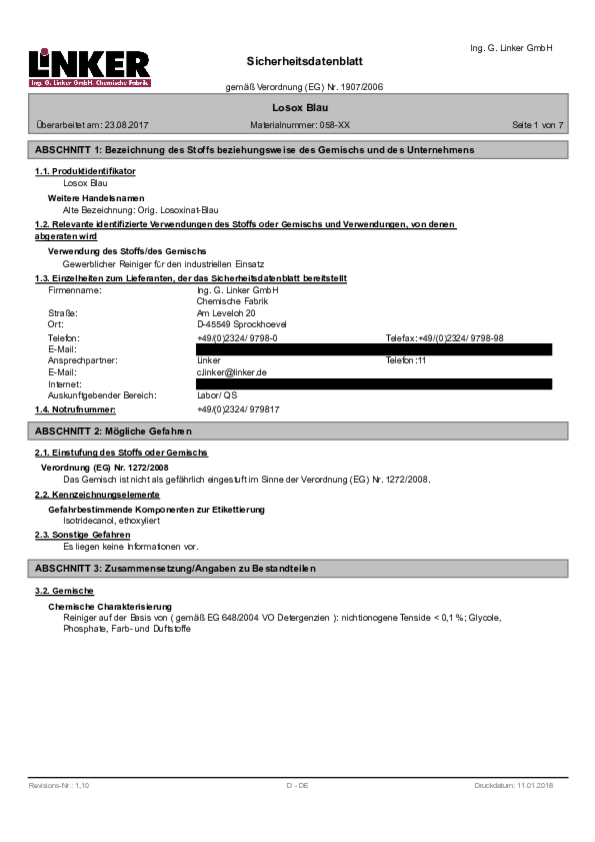
Removes dirt and oxidation residues, in particular zinc oxide, white rust and iron oxide, has a wash-active effect, removes dirt, soot, grease, oil and a range of other contaminants. Passivates and phosphates, providing temporary protection against corrosion.
To achieve full effectiveness during application, the zinc surfaces to be cleaned must be carefully wet-sanded with abrasive fleece (not steel wool). In the case of very heavy soiling, the application is repeated.
Afterwards, rinse or wash with water and allow to dry thoroughly. Pay particular attention to corners and overlapping surfaces!
Rinsing with water can be dispensed with provided that, immediately after treating small surface sections, the still-wet surface is rubbed dry and a non-sticky, deposit-free zinc surface is achieved.
When used correctly, hot-dip galvanised surfaces are not attacked so severely that material loss need be feared.
Zinc cleaner can produce firmly adhering white-grey deposits on zinc surfaces that considerably alter the appearance and, for visual reasons, make a subsequent coating of the zinc surfaces necessary.
Cleaning with chain flails
The use of chain flails on LORO-X stainless steel drainage pipes is possible. Smooth chains made of non-rusting stainless steel should be used. The use of foreign iron can initiate corrosion spots.