
LORO-X Spout
Typically, the main drainage is carried out via the parapet into the ground pipe with a downpipe. For emergency drainage, a downpipe with an outlet bend to the outside is also preferred. For optical or cost reasons, emergency drainage is sometimes also carried out as a so-called spout, without a downpipe.
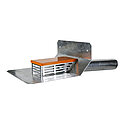
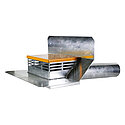
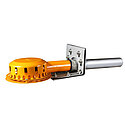
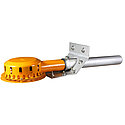
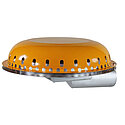
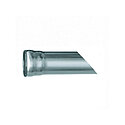
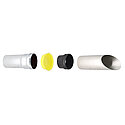
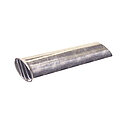
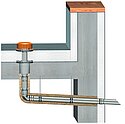
Different discharge capacities for one drain?
Spouts without downpipe are not able to develop an efficient siphonic flow.
In the case of a so-called “overloaded gravity flow” and “siphonic flow” the accelerating effect of the downpipe does not exist. This leads to a lower discharge rate.
The test setups for parapet drains that are described in the current DIN EN 1253 standard allow a test with or without downpipe for the determination of the discharge capacity.
That is why leading producers indicate at least two discharge rates for parapet emergency drains: on the one hand the discharge capacity with downpipe and on the other hand the discharge capacity without downpipe as spout.
The current DIN 1986-100 demands explicit minimum runoff coefficients for emergency drains with gravity flow for the case of a water congestion of 35 mm above the overflow edge. The height of the overflow edge for emergency drains can vary depending on the usage of an integrated weir or a higher installation of the whole drain.
Usually, a weir height of 40 mm is used for the main drainage with gravity flow and a 60 mm weir height for the main drainage with siphonic flow.
What is a Spout?
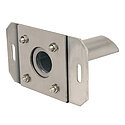
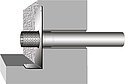
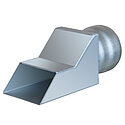
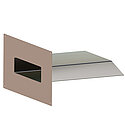
A spout is a drainage system without a downpipe, where the drain pipe directly represents the outlet to the outside. Spouts are mainly used as emergency drainage. A distinction is made between emergency drains with higher flow rates and emergency overflows for small areas. The outlet can be round or rectangular (e.g., for facades with clinker bricks).
When using spouts, the water from the roof is "bundled" as a water jet from the roof surface. The effects on the area below must be considered during planning. Without a downpipe, wind can push the falling water jet back against the facade, which can cause dark discoloration in this area over time.
Are Spouts without Downpipe Permitted?
Spouts as drainage without downpipe and without ground pipe connection should generally be treated like emergency drainage with an outlet onto a safely floodable area. In DIN 1986-100 5.3.1, clear rules are specified for spouting from balconies and roofs:
- "Rainwater must not be systematically discharged onto public traffic or pedestrian areas."
- Rainwater must be able to "drain or seep away unhindered and without affecting third parties."
Furthermore, the following points should also be considered when using spouts:
- The inlet of the spout should be secured against the entry of objects to reduce the danger from falling stones.
- The spout pipe should protrude from the facade with a drip edge and should not be flush with the facade, as water running down the facade can cause dark discoloration.
- The cross-section of the spout outlet should be at least equal to the cross-section of the inlet to avoid affecting the flow. This is also observed when transitioning from round to rectangular.
What is the Difference between Emergency Drain and Emergency Overflow?
Emergency overflows are simple round or rectangular holes in the parapet that are positioned above the drainage level. Since the flow capacity of emergency overflows is usually insufficient, high-performance emergency drains as spouts with proof of performance are preferred.
The increasing number of heavy rain events requires safe emergency drainage to the outside. If a downpipe cannot or should not be used for architectural reasons, spout solutions without a downpipe should also meet the minimum flow values of the standard.
At What Height are Emergency Overflows Installed?
Emergency overflows in the parapet are installed at a height that corresponds to the weir height of emergency drains with a retention element. Example: If the main drainage is designed with gravity flow at 35mm water height on the roof and a safety margin of 5mm is considered, the lower edge of the emergency overflow in the parapet is installed at a height of 40mm above the surface to be drained.
Do the Minimum Flow Values Also Apply to Spouts?
LORO-X emergency drains exceed the minimum flow values even as spouts!
Most parapet gullies available on the market do not achieve the minimum flow required by the standard of 4.5 liters per second at 35 mm overflow in DN 100 as a spout, but only in combination with a special test setup with downpipe. However, if the gully is installed without a downpipe, the flow values determined with this test setup can no longer be achieved.
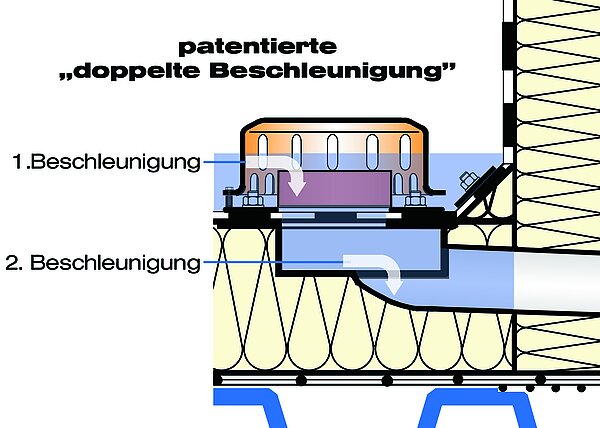
In order to achieve the minimum flow values required by the standard even as a spout, special designs of the drains are necessary, through which the flow performance is increased, for example our patented "double acceleration" (see graphic).
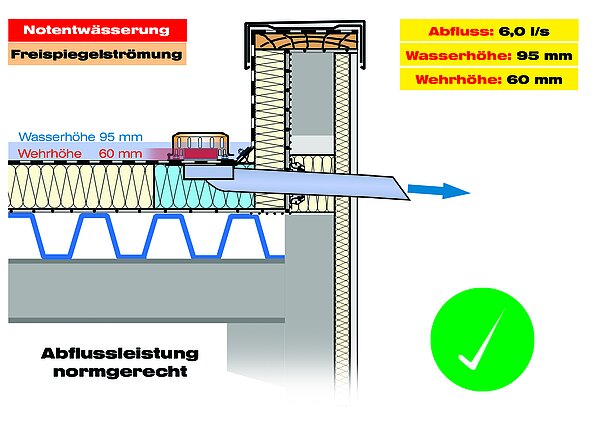
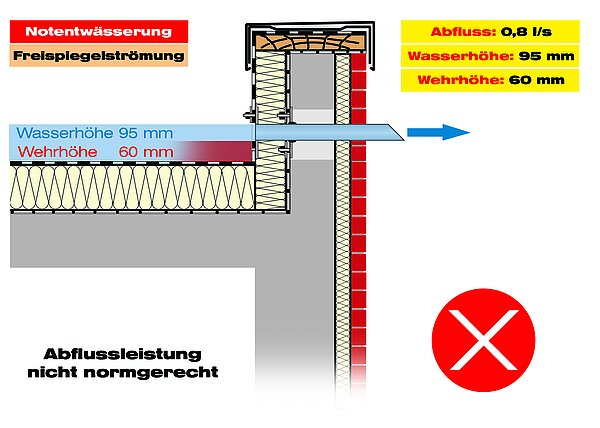
Using two application examples, the performance of LORO-X emergency drains (DN 100) compared to conventional emergency overflows (DN 100) is shown. The building requirements are the same in both cases for objective comparability:
(1) Maximum permissible water height on the roof = 75 mm.
(2) Retention of emergency drainage = 60 mm.
(3) Available overflow for emergency drainage = 75 - 60 = 15 mm.
While the LORO-X RAINSTAR emergency drain clearly exceeds the minimum flow values even as a spout without downpipe, the conventional spout only achieves a fraction of this performance.
As Spout or with Pipe System?

Due to the high performance, modern siphonic flow systems via the parapet, with LX data sheet as proof of performance, are often used for emergency drainage to the outside. The number of necessary drains and parapet breaches is thus significantly reduced.
To achieve the flow of 32 liters per second at 75 mm water height on the roof with a weir height of 60 mm of a LORO-X ATTIKASTAR DN 100 with conventional spout pipes DN 100, 106 x round spouts at an installation height of 60 mm must be installed.
At an overflow of 15 mm, these achieve approximately 0.3 liters per second at 75 mm water height on the roof.
Demand Proof of Performance for Spouts!
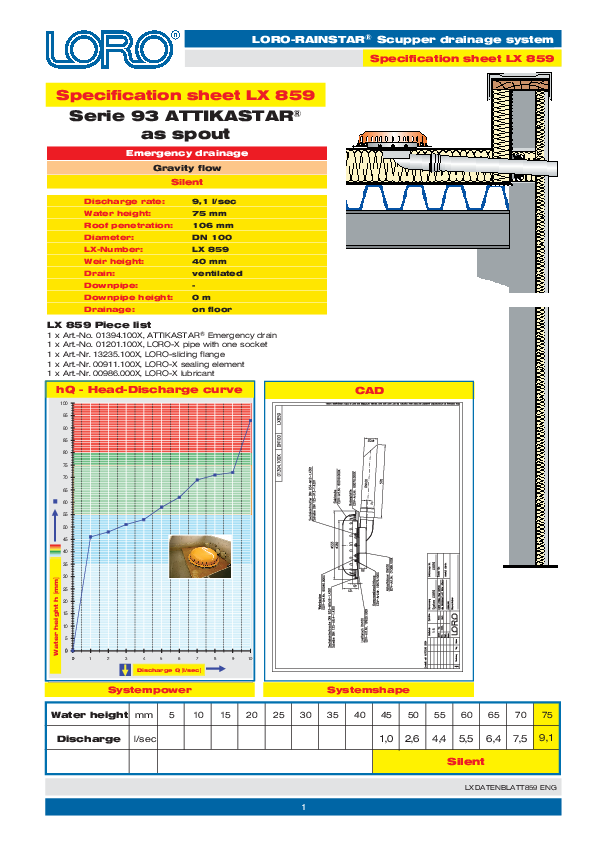
Spouts without downpipe represent a special installation situation for parapet drains, where lower flow performance can occur than was determined with the standard test setup for this drain. The accelerating effect of the downpipe in so-called "surcharged gravity flow" and "siphonic flow" is not available, which leads to lower flow performance.
Since the manufacturer specifications for drains usually state - for advertising reasons - the higher flow performance with closed downpipe, the performance as a pure spout without downpipe is often insufficiently proven. Leading manufacturers therefore provide at least 2 flow performances for parapet emergency drains: On the one hand, the flow performance with closed downpipe and on the other hand, the flow performance with ventilated or without downpipe as a spout.
When using parapet drains as spouts, therefore pay attention to the manufacturer specification without downpipe and compare this value with the minimum flow values of DIN 1986-100. Trust clear proofs of performance, such as the LX data sheets from LORO.