
LORO-X Composite Pipes
Double-walled steel discharge pipe with built-in thermal and sound insulation
Description
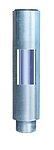
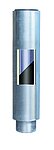
The LORO-X composite pipe is a double-walled, thermally insulated and sound-insulated waste water pipe with internal LORO-X push-fit socket connection.
It is always used when protection against condensation and noise is the main focus. Especially in visible areas, the LORO-X composite pipe is an attractive alternative to sheathing applied on site.
Advantages at a glance
- factory-insulated with rigid PU foam
- impact- and shock-resistant
- easy installation thanks to push-fit socket connection
- non-combustible acc. to DIN 4102 and DIN 1986
- available with self-regulating pipe trace heating
- wide range of applications thanks to different pipe materials
- significantly improved sound insulation values in the "SILENT" version
Sound insulation and condensation prevention
with thermally insulated LORO-X composite pipe
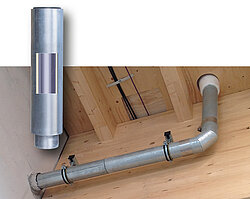
Flat roof drainage systems with pipes in the building place special demands on the pipe system in terms of sound and heat insulation, as the cold rainwater from the roof is often directed into the building at high flow rates.
Double-walled LORO-X composite pipes made of solid steel with sound and heat insulating filling made of PU foam solve both problems at the factory and offer the impact-resistant and visually appealing surface of the hot-dip galvanized steel.
The drainage pipes often have to be laid in the vicinity of rooms in need of protection. For example, privately used bedrooms or commercially used office spaces in which people work in a concentrated manner may require protection. The boundaries between commercial and private requirements are becoming increasingly blurred when parts of a commercial building are also used privately.
In addition, LORO-X composite pipes are tested as R90 pipe penetrations for walls and ceilings, so that the pipe system can be routed safely and with little effort through several fire protection areas in the building.
Protection against condensation
LORO-X composite pipes consist of two thermally separated steel drainage pipes
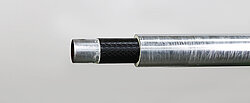
The cold rainwater - the temperature of which in winter can only be just above freezing point - is fed through the insulated roof structure into the heated building. But even when it's not raining, colder air flows through the pipes. With conventional pipes, this can lead to so-called "condensation" with condensate dripping off in the building. In the long term, this also means additional energy expenditure, since the heating system has to "fight" against the cold pipe system. For this reason, insulation that has been purchased separately is often installed around the pipe system on site.
- DIN 1986-100 6.3.2: "Internal rainwater pipes must be insulated against condensation if the temperature and humidity in the building require this." Exactly when this is necessary is not described in detail and must be decided on a case-by-case basis during planning.
A sensible measure against condensation is the double-walled LORO-X composite pipe, which consists of two thermally separated steel drainage pipes at the factory. The 12-28 mm thick PU layer running between the pipes ensures that the lower temperature on the inner pipe carrying the medium is maintained and that no dripping condensation water forms on the outer pipe at room temperature.
If extreme temperature differences are often to be expected, or the pipe system runs through rooms that are particularly worthy of protection (e.g. server rooms or high-quality and sensitive machines), LORO-X composite pipes are optionally available with self-regulating surface heating tape on the inner pipe.
Protection against flow noise
A massive and highly soundproof drainage system is created from LORO-X composite pipes
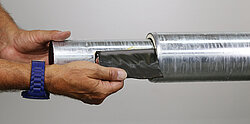
The roof drainage pipe systems often run inside buildings behind suspended ceilings or walls with low sound insulation. The water flowing in a pipe system naturally generates flow noise, which is often only noticed later in the office or living spaces during ongoing operation.
As a preventive measure to reduce flow noise, LORO-X composite pipes show particularly favourable acoustic behaviour - partly due to the high specific weight of the double-walled steel compared with conventional plastic pipes. As a result, the requirement for the necessary sound insulation value of suspended ceilings and walls can be reduced compared with other pipe types. Detailed acoustic reports are available on request.
For particularly high sound insulation requirements (e.g. bedrooms, hotel rooms, offices), LORO-X composite pipes are available in the "SILENT" version, which are factory-fitted with an additional 2.5 mm thick sound insulation film based on bitumen and plastic. This film is applied at the factory to the inner pipe and is not visible from the outside.
DIN 1986-100 8: "The noise behaviour of a drainage system in connection with the building must be taken into account during planning and installation. The permissible noise levels are specified in DIN 4109."
The factory-made and visually appealing solution

When planning internal roof drainage systems, it should be checked in advance whether the measures for heat and noise protection should be carried out with additional measures on the building? The use of factory-made LORO-X composite pipes in nominal sizes DN 40 to DN 150 is often the high-quality and quick-to-install alternative.
The massive outer tube - without any sensitive on-site sheathing - also provides permanent protection against mechanical influences in the following years and can therefore also be used in areas that are in use. At the same time, the well-known LORO-X push-in socket connection in the inner pipe enables quick and safe assembly, while the sleeveless outer pipe offers a consistently attractive appearance.
Of course, all LORO-X composite pipes are compatible with the single-walled LORO-X steel drainage pipes and LORO-XCL stainless steel drainage pipes.
Special solutions: Straight pipes are also available as a special solution in which the inner pipe and outer pipe, made of hot-dip galvanized steel or stainless steel, can be combined, depending on the requirements. In the case of molded parts such as bends or branches, the inner and outer pipes are either both made of hot-dip galvanized steel or of stainless steel.
What standard do composite pipes fall under?
In general, the respective drainage standards refer to the media-carrying pipe, as in our case to DIN EN 1123 or DIN 1986 - T4. Our LORO-X composite pipe consists of 2 LORO-X steel drainage pipes according to the standards mentioned with two nominal widths, whereby the inner pipe is the media-carrying one. There is no special test standard for the combination with factory condensation water insulation.
Inner pipe: LORO-X steel drainage pipe, according to DIN EN1123 / DIN EN ISO1461, hot-dip galvanized, with additional inner coating (standard version). Additionally on the outside with soundproofing film for increased soundproofing requirements ("SILENT" version). Custom-made on request: LORO-XC stainless steel pipe.
Insulation layer: The bond between the inner and outer pipe is created by factory foaming with rigid polyurethane foam, CFC-free.
Outer pipe: steel, hot-dip galvanized (standard design).
In terms of tightness and usability, we can refer to decades of good experience with LORO-X composite pipes.
LORO-X Sound Insulation
LORO-X sound insulation for internally routed drainage systems