Products for set-back storeys
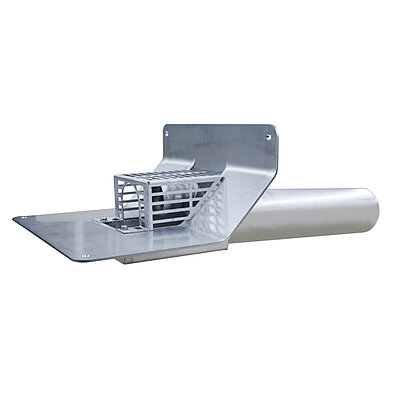
LORO-X QUATTROFLUX Set-back storey drainage
Trend towards set-back storeys with increased drainage requirements
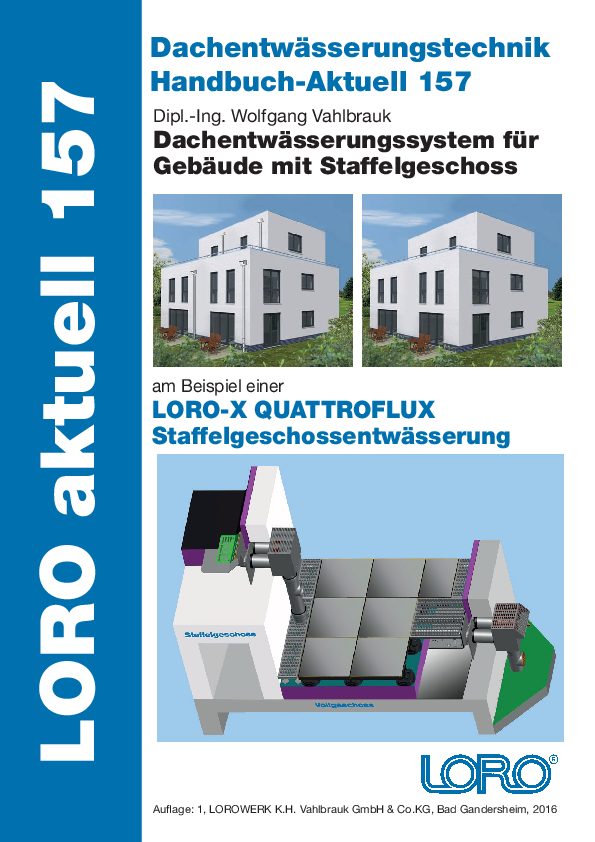
In modern residential construction, there is a tendency to live in the city with the feeling of living "in the countryside". This includes at least a balcony or loggia; even better, a larger roof terrace. The densification of urban living space through "building extensions" - as set-back storeys on existing buildings - is also becoming increasingly important. Especially in large cities.
The roof terrace is a terrace above an inhabited room, which is of crucial importance for moisture protection, thermal insulation and sound insulation. Every set-back storey drainage system must therefore meet special requirements, as standard or object-specific.
Rainwater from the roof must generally not be directed onto balconies and terraces below and must therefore be routed through pipes over these surfaces in a closed system. The water from the roof must therefore be conducted in a controlled and safe manner across the roof terrace without flooding it.
A closed pipe system offers increased safety compared to open branch channels.
With LORO-X set-back storey drainage systems, the complete drainage of roof and roof terrace can be realised as a holistic roof drainage solution for outdoor seating areas.
4 flow paths in 1 system

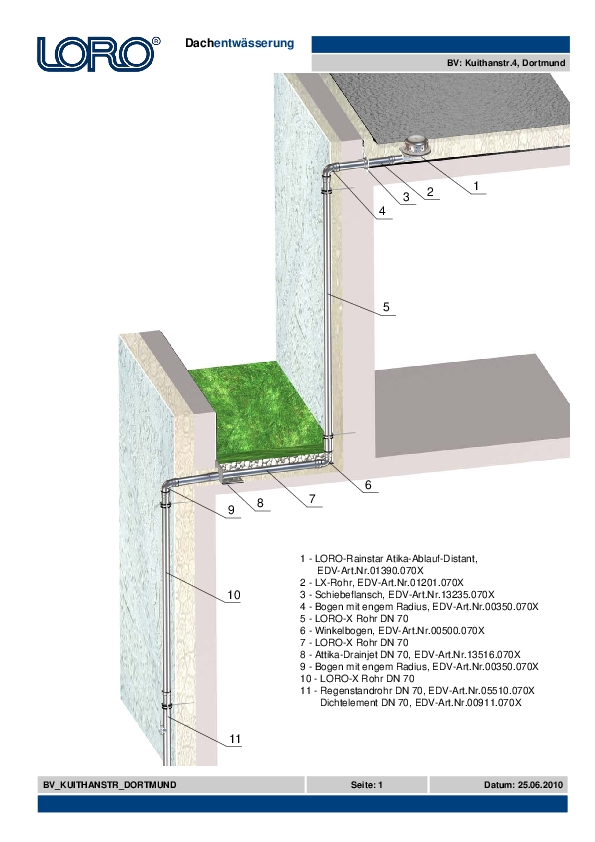
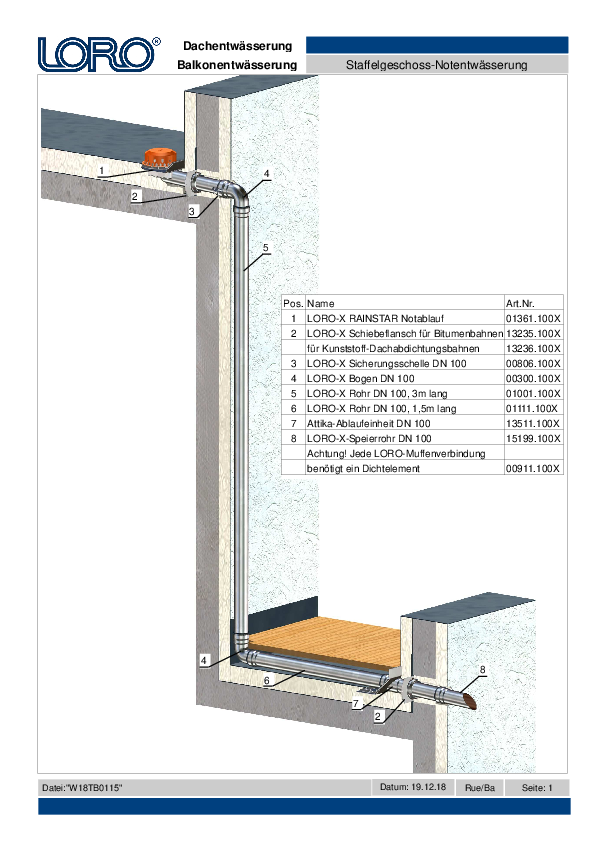
Set-back storey drainage as parapet drainage should be installed as inconspicuously as possible on the building facade. Nevertheless, the main and emergency drainage of the roof and roof terrace must be implemented.
This means that 4 separate flow paths must be planned.
Flow path 1: From roof to ground drainage
Flow path 2: From roof to open air
Flow path 3: From roof terrace to ground drainage
Flow path 4: From roof terrace to open air
As a prefabricated roof drainage system with measured performance verification, the new LORO-X QUATTROFLUX set-back storey drainage offers high safety in planning and installation with only one visible downpipe instead of four.
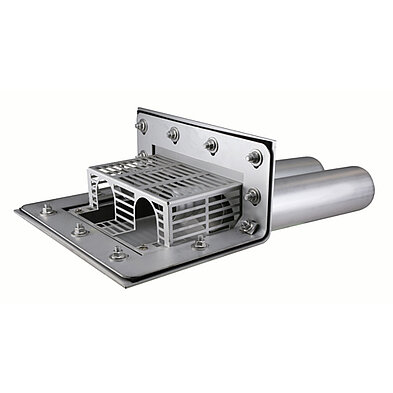
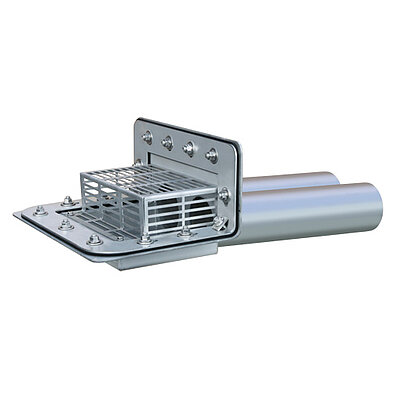
In the main-emergency combination parapet drain of the roof terrace, one pipe serves the flow path of the main drainage and a second pipe serves the flow path of the emergency drainage - as in the main-emergency combination parapet drain of the roof.
Silent pressure flow with overpressure
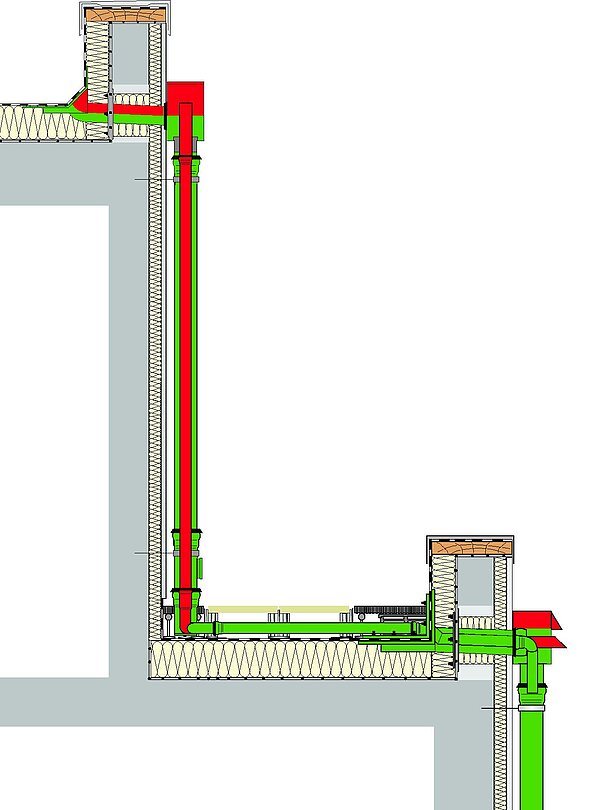
When draining the roof, a pressure flow with overpressure is created in the downpipe between the roof and the roof terrace.
This "pushes" the water - against the frictional resistance of the two horizontally lying DN 50 pipes - without gradient and without disturbing suction noises across the roof terrace.
The two horizontal pipes have a small diameter of DN 50, so that a low construction height of the roof terrace covering is possible.
The installation of the two horizontal, pressure-resistant DN 50 pipes is quick, simple, safe and dimensionally accurate with the LORO-X socket joint connection.
Low heights
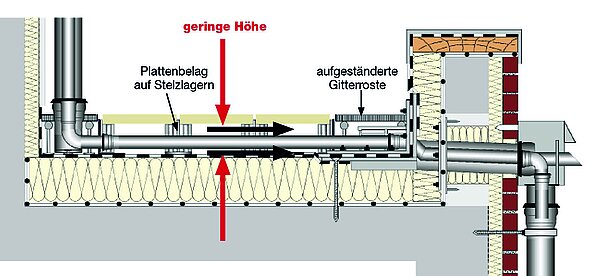
So that the drainage of the roof does not occur on the roof terrace, it is routed below the covering of the roof terrace through pipes over the full storey.
The "speed" - i.e. a high drainage with low water height - is an important aspect in set-back storey drainage, as the height of the roof terrace covering often limits the water height.
Including emergency drainage and backflow protection
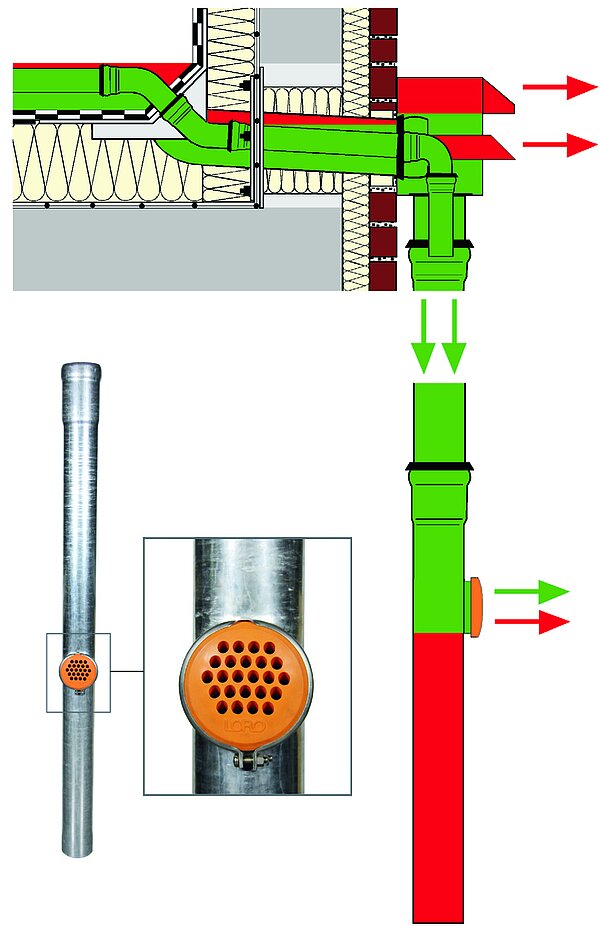
The emergency drainage of the roof and roof terrace is carried out by the LORO-X QUATTROFLUX collection box as a scupper into the open air.
In case of backflow from the ground drainage, the high-performance safety overflow (HSÜ) in the rainwater standpipe additionally secures the emergency drainage into the open air in addition to the main drainage.
Architecture


Buildings with set-back storeys often have to meet the highest architectural and aesthetic standards, especially when designing the facade if drainage is carried out externally as parapet drainage. The parapet drainage of set-back storey drainage should be as visually unobtrusive as possible on the facade of the main view of the building.
With LORO-X set-back storey drainage, the roof and roof terrace are architecturally and technically "safely optimally drained".
Conventional
Conventional set-back storey drainage requires 4 pipes on the facade for roof and roof terrace drainage with main drainage and emergency drainage (Image 2). Complete drainage of roof and roof terrace conventionally requires numerous visible pipes on the facade, which is often architecturally undesirable.
With LORO-X
Instead of up to 4 visible pipes in the main view for draining the roof and roof terrace with main drainage and emergency drainage, there is only one visible pipe (Image 1).
LORO News

Video: Assembly step by step
Alternative solutions
Set-back storey pipe penetration without multi-storey drain