
LORO-X Roof Drainage Systems in Ventilated Rainscreen Facades (VHF)
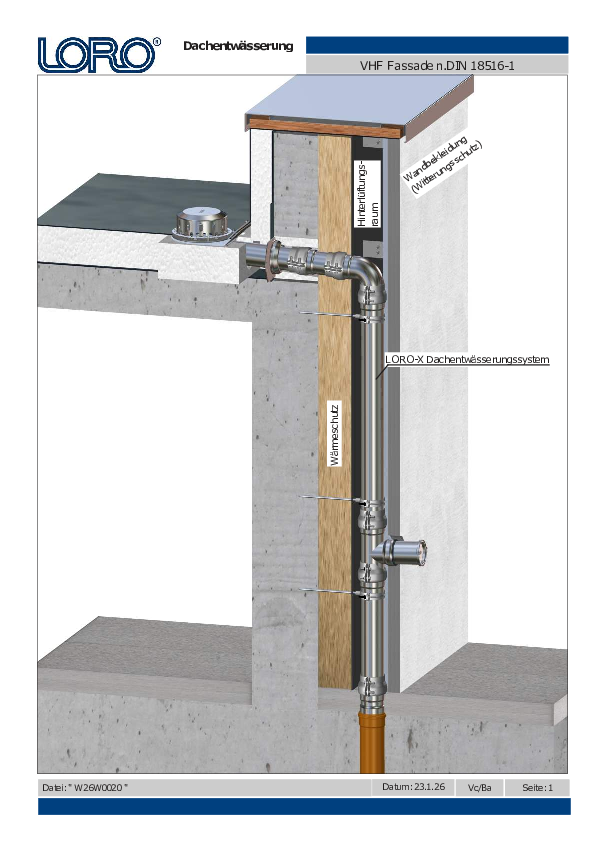
The ventilation cavity of VHF facades according to DIN 18516-1 is ideally suited for integrating LORO-X parapet drainage systems. LORO-X steel drainage pipes can be routed invisibly between insulation and facade cladding – protected, maintenance-friendly and fire-safety compliant.
Design Principle
The VHF structurally separates thermal protection and weather protection. Between mineral insulation and the outer cladding, a ventilated cavity is created that removes moisture through a permanent airflow. This cavity simultaneously provides space for downpipes – a third option alongside visible external mounting and internal pipe systems.
Massive LORO-X steel drainage pipes are also acoustically more favourable than thin-walled pipes due to their material properties. Flow noise in the downpipes is partly absorbed by the insulation layer.
Fire protection: LORO-X pipes made of hot-dip galvanised steel or stainless steel, building material class A1 – non-combustible, are optimally suited for the requirements of the FVHF fire protection guideline (2016).
Maintenance: VHF cladding elements can be dismantled. For repairs, the facade is opened section by section. LORO-X cleaning pipes enable easy cleaning within the downpipe.
LORO-X System Components
- Parapet drains: With transition from flat roof to downpipe in the facade
- Scuppers and rectangular scuppers: Alternative for external water routing
- Downpipes and fittings: Complete steel drainage pipe system with bends, branches, cleaning pipes
Planning
Integration requires coordination between facade and MEP planners. Pipe fixings and the dimensioning of the ventilation cavity according to pipe diameter, e.g. DN 50 / DN 70, are coordinated.
Sustainability
The VHF enables material-separated dismantling and reuse of all components. LORO-X steel drainage pipes are 100% recyclable. The material combination of steel, mineral insulation and ceramic cladding achieves service lives of several decades.
Advantages at a Glance
- "Invisible" pipe routing
- No pipes inside the building, full use of interior space
- Fire-safety compliant, non-combustible (A1)
- Demountable facade and cleaning pipes for maintenance
- Recyclable materials