
Safety measures
Three safety measures for safe roof drainage systems in view of increasingly frequent heavy rainfall events
How can the safety of roof drainage installations be increased to cope with future heavy rainfall events?
In recent years and decades, meteorologists have observed an increase in heavy rainfall events. The German Weather Service notes: "Heavy rain can occur anywhere and lead to rapidly rising water levels and (or) to flooding." (DWD). Today's designs of flat roofs must take safe drainage into account at least over the expected service life of the roof. On average, this is 30 years.
On roof surfaces, too, heavy rainfall can lead to rapidly rising water levels and thus to structural overloading if the roof drainage systems are not dimensioned strongly enough for the necessary heavy-rainfall discharge. The current drainage standards already use the historically measured hundred-year rainfall per postcode area for dimensioning the emergency drainage. However, this is statistical data from past years.
What has so far been calculated statistically per postcode will probably be able to occur everywhere in the future. Climate researchers thus point "to an increase in the frequency and intensity of heavy precipitation" compared with previous statistics (German Environment Agency).
1st safety measure: use higher rainfall intensities
Apply safety margins in the calculation

The design rainfall intensities used as a basis for planning have a major influence on the calculation of roof drainage. These local design rainfall intensities are issued per postcode by the DWD under the name KOSTRA, based on "evaluations of historical rainfall events and statistical calculations" (Coordinated Heavy Rainfall Regionalisation Analyses). This regional evaluation results in the wide range of differing local rainfall intensities, depending on the postcode.
This local rainfall intensity is then used in the drainage calculation in accordance with the standard to calculate the necessary discharge of the roof drainage in litres per second. The "normal" rainfall intensity for the main drainage and the "hundred-year" rainfall intensity for the emergency drainage.
In Denmark, recommendations for a "climate factor as a surcharge" for different durations and frequencies were already drawn up in 2008. "Depending on duration, return frequency and the method used, the factors range between 1.1 and 1.5." In Germany, too, forecasts lead to similar factors (source).
Safety measure: instead of calculating with the statistical rainfall intensity for the postcode of the construction project, the highest rainfall intensity across Germany is increasingly being used for the drainage calculation of the emergency drainage, since no one can predict in which postcode area the next heavy rainfall is to be expected. Alternatively, calculations are also carried out with safety margins on the current local rainfall intensities, in order to take into account the trend towards more intense rainfall events.
2nd safety measure: plan more powerful emergency drainage
Safeguard against failure of the main drainage

In a heavy rainfall event, the emergency drainage either serves to support the main drainage with additional discharge for the heavy rain (emergency case 1), or, in the event of simultaneous backflow from the underground drain, must additionally be able to take over the full discharge of the main drainage (emergency case 3).
Since "emergency case 3" can occur in particular during heavy rainfall events, with flooded streets and overloaded underground drains, the emergency drainage should be dimensioned strongly enough to be able to drain the full hundred-year rainfall on its own as well.
Safety measure: in order to be able to drain the maximum discharge of the hundred-year rainfall at minimum water level on the roof on their own, the external LORO-X RAINSTAR parapet drainage systems and the internal LORO-X DRAINJET rapid drainage systems prove convincing as powerful emergency drainage with siphonic flow and a patented weir beneath the dome.
3rd safety measure: protect against backflow from the underground drain
Drain backflow from the underground drain to the outside
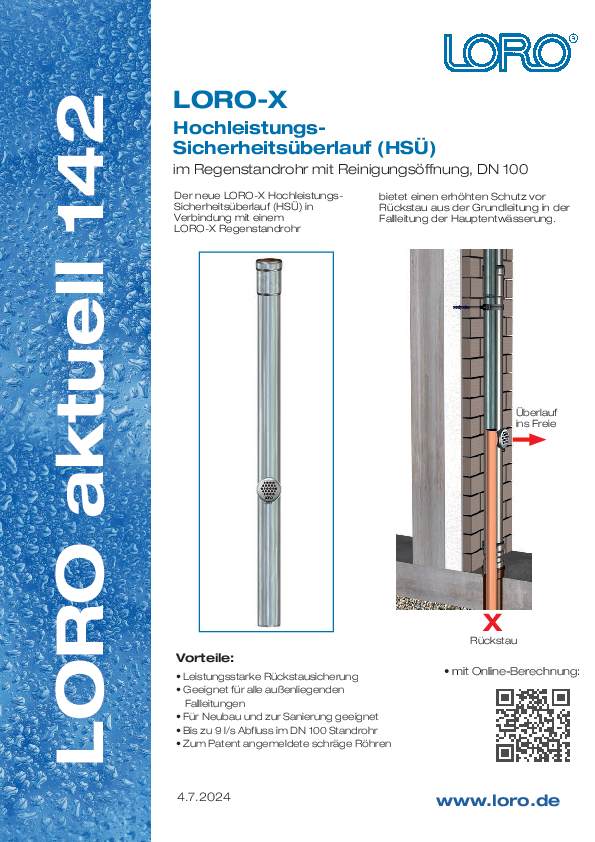
Heavy rainfall affects the drainage systems not only from the roof surface, but also "from below" out of the underground drain. Since heavy rain falls on all buildings and surfaces in the surroundings at the same time and is discharged from all of them into the underground drain simultaneously, the underground drains are often loaded up to the point of being completely full.
This overloading of the underground drain can lead to backflow in the connected downpipes, which can reach connected balcony or roof surfaces if no suitable backflow protection is provided.
Safety measure: in order to protect external downpipes of gutters, balcony drainage and parapet drainage against backflow, the LORO-X HSÜ (high-performance safety overflow) in combination with the LORO-X rain stand pipe has proven its worth.