
Emergency drainage
The additional emergency drainage to the outside serves as a safeguard against three "emergencies" at every low point
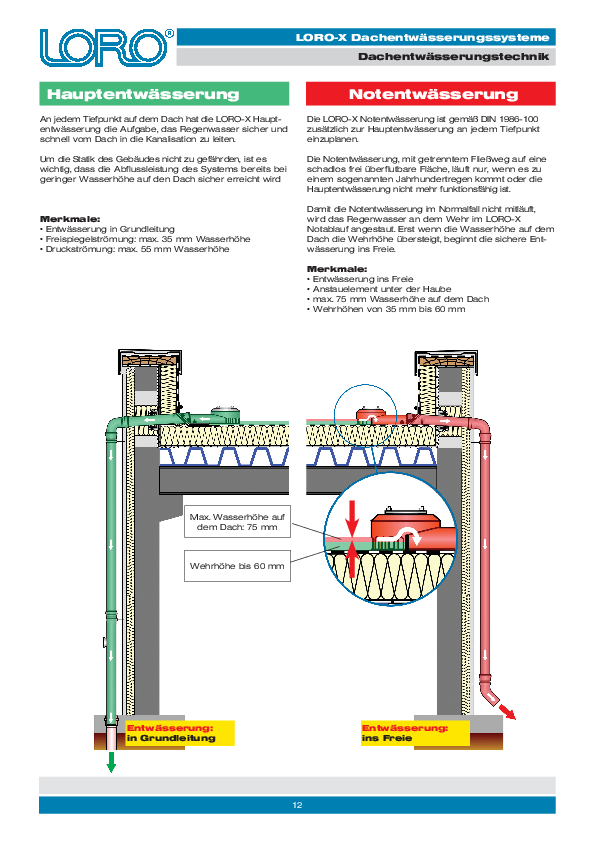
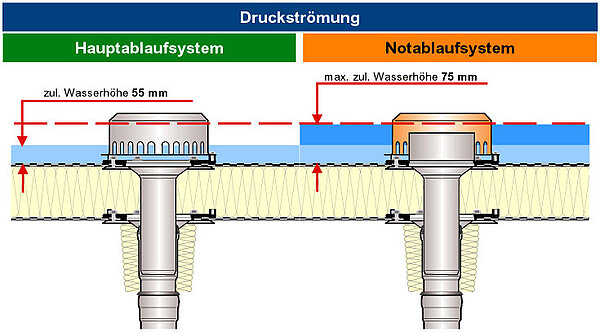

Emergency drainage always begins to drain whenever the planned standard rainfall intensity (r5,5) is exceeded. The flow path of the emergency drainage must not be connected to the underground drain, but instead discharges via a separate flow path onto a surface "that can be flooded freely without causing damage".
While the main drainage should be connected to the underground drain with a backflow-proof downpipe, emergency drainage is usually carried out by a high-performance parapet drainage with discharge to the outside.
What is an emergency outlet?
An emergency outlet is an outlet for emergency drainage with a built-in retention element (weir), so that discharge to the outside only takes place once a defined water level has been reached.
Where facade protection is not a concern, scuppers with a lower drainage capacity can also be used for small roof areas.
Since the emergency drainage should be prevented from draining simultaneously during every normal rainfall, emergency outlets are equipped with a retention element (weir), so that emergency drainage only begins once a defined water level on the roof has been reached.
In order to keep the roof load as low as possible despite the retention element, innovative emergency outlets with a retention element beneath the dome can be used for siphonic flow, for example, with which the full capacity is already achieved at a low water level on the roof.
3 emergencies
Emergency 1
A once-in-a-century rainfall event occurs in which the main drainage requires additional support from the emergency drainage running in parallel.
Emergency 2
During normal rainfall the main drainage fails, so that the emergency drainage has to take over the entire drainage capacity of the main drainage.
Emergency 3
A once-in-a-century rainfall event occurs and at the same time the main drainage fails, because the underground drain is overloaded for example, so that the emergency drainage should be able to handle up to twice the drainage capacity of the main drainage.
Safety
In order to be prepared for emergencies 1 and 2, it is therefore generally recommended that the drainage capacity of the emergency drainage be at least as high as the drainage capacity of the main drainage.
For maximum safety, including in emergency 3, the emergency drainage should be designed with twice the drainage capacity of the main drainage, or for the full once-in-a-century rainfall event.
Height-variable emergency drainage
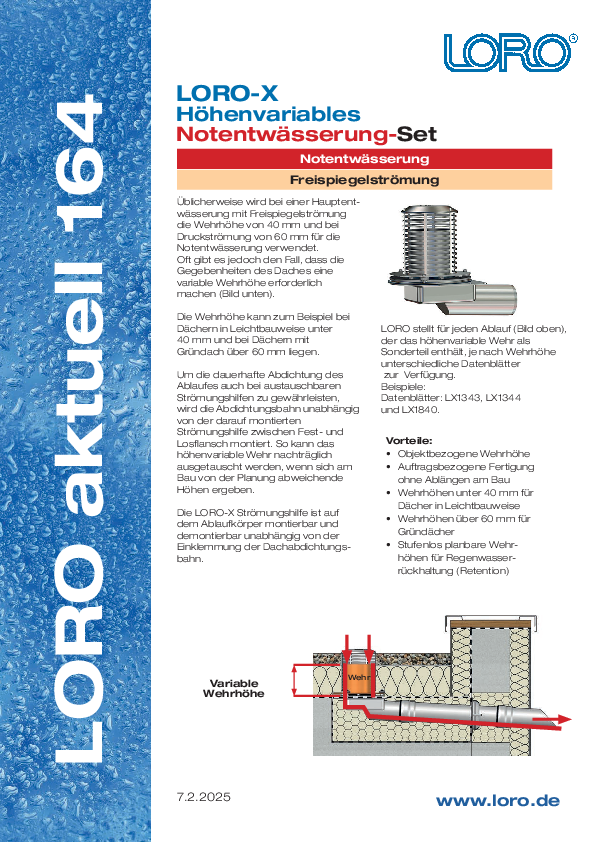
For main drainage with gravity flow a weir height of 40 mm is usually used, and for siphonic flow a weir height of 60 mm, for the emergency drainage.
However, there are often cases in which the conditions of the roof make a variable weir height necessary.
The weir height can be below 40 mm for lightweight roof constructions, for example, and above 60 mm for roofs with a green roof or retention.
Advantages:
• Project-specific weir height
• Order-specific fabrication without cutting to length on site
• Weir heights below 40 mm for lightweight roof constructions
• Weir heights above 60 mm for green roofs
• Infinitely adjustable weir heights for rainwater retention (retention)
You can find further information in the LORO Aktuell 164.